Biospecimen
Biosample collection (Blood, Urine, Stool, Skin Biopsy)
About#
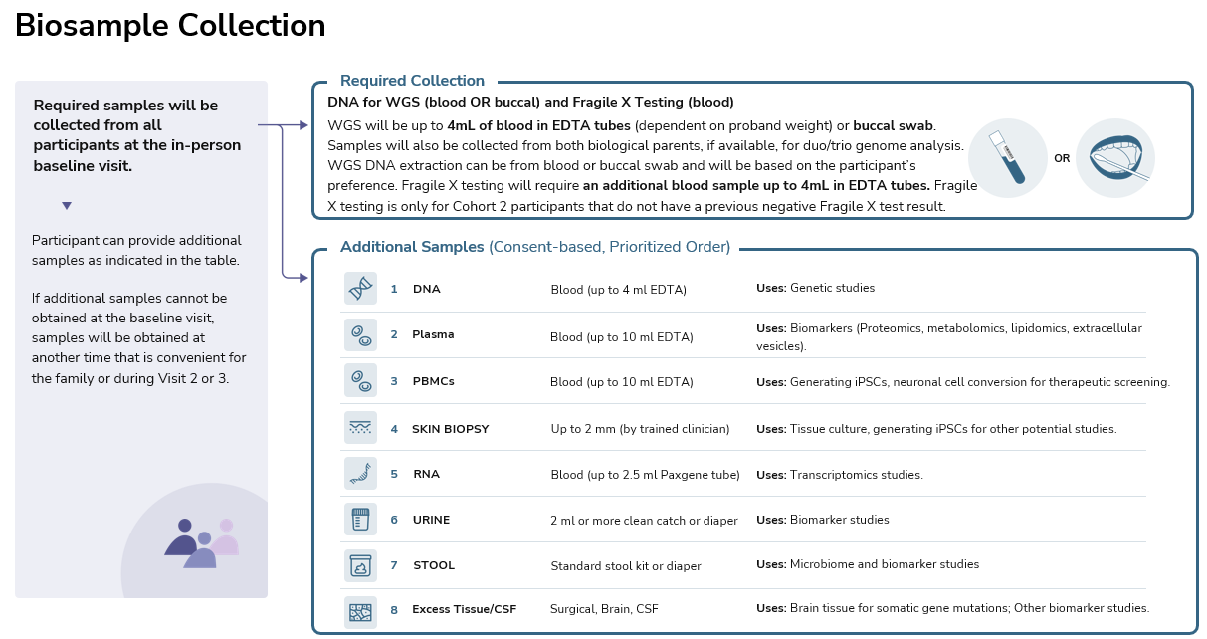
Samples will be collected from all participants, affected siblings (who meet cohort 1 or 2 criteria) and biological parent(s) (when available) at the in-person baseline visit. If samples cannot be obtained at that time, samples will be obtained at another time that is convenient for the family or during subsequent study visits. Only a blood or cheek/buccal sample for WGS and a blood sample for FXS testing (if not done previously for participants in cohort 2) are required at the Baseline visit. Although preferred at the Baseline Visit, the additional samples may be collected at any time during study participation, if feasible. Participants will be given the option to provide additional samples as indicated below.
Required at Baseline Visit for Proband and Biological Parent(s)
- DNA for WGS (via blood OR cheek/buccal): Depending on participant preference, a blood sample (up to 4 ml) or cheek/buccal sample will be collected from all participants, affected siblings and both biological parents, if available, for duo/trio whole genome analysis.
- DNA for FXS testing (via blood): For participants in cohort 2 who have not had FXS testing with a documented negative result, a blood sample (up to 4 ml) will be collected for FXS testing.
Additional (If feasible and in order of scientific priority)
- DNA: Up to 4 ml of blood for use in potential genetic (DNA) studies that include, but are not limited to, methylation signatures required to confirm/refute pathogenicity of a variant; methylation signatures.
- Plasma: Up to 10 ml of blood for use in biomarker studies that include, but are not limited to, proteomics, metabolomics, lipidomics, extracellular vesicles.
- iPSCs (induced pluripotent stem cells): Up to 10 ml of blood for peripheral blood mononuclear cells (PBMCs) for generating iPSCs and transforming them into neuronal cell types for drug screening and other studies.
OR
Up to 2 mm of skin punch biopsy (participants ages 0–2 yrs) collected by a trained clinician for generating iPSCs and transforming them into neuronal cell types for drug screening as well as other studies. - RNA: Up to 2.5 ml of blood for potential use in studies of transcriptomics.
- Urine: Collected at home for biomarker/proteomics studies (participants and affected siblings only, not parents).
- Stool: Collected at home for potential biomarker studies including the microbiome (participants and affected siblings only, not parents).
- Excess tissue/CSF samples (e.g. surgical specimens, brain tissue and CSF): For biomarker studies including identification of somatic gene variations from brain tissue. CSF may also show gene changes similar to those in the brain (participants and affected siblings only, not parents).
When possible, blood draw will be combined with clinically indicated draw to minimize the need for additional venipuncture and the total blood volume collected will not exceed each IMPACT site’s institutional guidelines for participant age and weight.
Administration
| Administration type | Direct Assessment |
|---|---|
| Setting | In-Person |
| Duration | {} |
| Respondent | Child, affected siblings (who meet cohort 1 or 2 criteria), and biological parents (as available) |
| Visits | Visit 1 |
| Ages | 0-18 years |