Protocol Synopsis
Innovative Medicine and Precision Approaches to Clinical Trials (IMPACT) Longitudinal Natural History (LNHS) Study
At A Glance#
| Lead Investigators | Mustafa Sahin, MD, PhD and Shafali Jeste, MD |
|---|---|
| Lead Institutions | Boston Children’s Hospital & David Geffen School of Medicine, UCLA |
| Primary Objective | Longitudinally characterize behavioral, medical, neurophysiological, and genetic features of children with profound autism. |
| Study Rationale | There are significant gaps in clinical trial readiness in autism spectrum disorder (ASD). These gaps include: (1) the lack of evidence-based clinical endpoints, (2) a paucity of robust and hypothesis-driven biomarkers and (3) limited coordination and centralization of strategies to engage families in trials. This 5-year longitudinal natural history study is designed to address those gaps. |
| Study Design | Multisite prospective longitudinal natural history and clinical endpoint study |
| Funder | Coalition for Aligning Science (CAS) |
| Participants | Assuming the selection of 6 genes, a minimum of 1,250 participants (at least 100 per each genetic variant in Cohort 1 and at least 200 participants in Cohort 2) and their biological parent(s) when available ( at least 1,250 trios or 3,750 participants). |
| Duration | 5+ years (up to 2 years per participant) |
Terminology#
- Autism Spectrum Disorder (ASD) is used to refer to the diagnostic term, as defined by the Diagnostic and Statistical Manual of Mental Disorders - 5th Edition (DSM-5).
- Profound autism is used to refer to individuals with ASD who have significant cognitive and language impairment and require lifelong care, as defined by the Lancet Commission (PMID: 34883054).
- Likely profound autism is used in some sections to refer specifically to children who do not meet the definition of profound autism due to being less than 8 years of age, but who have significant cognitive and language impairment and are likely to meet the profound autism definition in the future. In general sections of this protocol, profound autism is used to refer to children both above and below 8 years of age.
Study Objective#
The primary study objective is to improve clinical trial readiness in ASD by generating fit-for-purpose clinical, developmental, and genetic data from cohorts with (1) specific genetically-defined disorders associated with profound autism or (2) behaviorally-defined profound autism to directly inform eligibility criteria, stratification strategies, and clinically meaningful outcome measures for future interventional trials.
Details
- To characterize baseline clinical, biological and developmental features, variability, and trajectories in cohorts with specific genetically-defined disorders or with profound autism, and to identify sources of heterogeneity that impact eligibility criteria, stratification, and feasibility of interventional trials.
- To evaluate the performance, sensitivity to change, and clinical meaningfulness of candidate outcome measures and biomarkers across functional domains relevant to profound autism, supporting selection of fit-for-purpose endpoints for future clinical trials.
- To examine genotype-phenotype relationships and their relevance to clinical outcomes to inform genotype-informed cohort selection, stratification strategies, and endpoint prioritization in clinical trials.
- To integrate clinical, developmental, biomarker, and genetic findings into practical recommendations for profound autism trial design, including eligibility criteria, stratification variables, endpoint selection, stakeholder engagement and feasibility considerations for near-term interventional studies.
Participant Population#
Inclusion Criteria at Baseline Visit#
- Cohort 1: Participants age 0 to 18 years of age with clinical documentation of a genetically defined disorder associated with profound autism, including a pathogenic/likely pathogenic variant in: ARID1B, GRIN2B (both GoF=gain of function & LoF=loss of function variants), RNU4-2, SCN2A (both GoF=gain of function & LoF=loss of function variants), SLC6A1 gene, or other genes of interest.
- Cohort 2: Participants age 2 to 18 years of age with profound autism/likely profound autism and either no previous genetic testing OR previous testing that was non-diagnostic.
Exclusion Criteria at Baseline Visit#
- Cohort 1: Age >18 years at time of enrollment.
Cohort 2: Age <2 or >18 years at time of enrollment. - Treatment with an investigational drug, biological agent, or device as part of another research study, within 30 days prior to study enrollment.
- Previous disease modifying treatment, including gene therapy or antisense oligonucleotide (ASO).
After WGS and Fragile X testing at the Baseline Visit, Cohort 2 will be split into 2 groups:#
- Cohort 2a (those with a definitive genetic cause for autism not identified)-will be followed over time
- Cohort 2b (those with the presence of pathogenic or likely pathogenic variant(s) in a neurodevelopmental gene other than one of the targeted genes of interest AND those that do not meet the criteria for profound/likely profound autism following Baseline assessment)- participation will end after the Baseline visit
Evaluation and Measurements#
Behavioral & Developmental Assessments#
Behavioral and developmental testing will be conducted at each visit. The testing will include direct assessment of participants as well as standardized parent questionnaires/surveys and parent interviews. Parent report measures will be collected electronically. Whenever possible, remote completion of parent questionnaires and interviews will be offered. Direct participant assessments will be completed in-person with qualified personnel at the study site. As noted below, some domains of assessment (e.g. cognition, language, motor) include multiple potential measures. Measures will be selected based on the participant’s developmental level to ensure accurate assessment. All assessments will be collected at each timepoint, unless otherwise noted below. The standard assessment battery will be conducted for all participants who are at least 24 months of age at the time of their visit (all Cohort 2 participants, many Cohort 1 participants). The infant battery provides alternate assessment options that are developmentally appropriate for children birth to age 24 months, as some Cohort 1 participants may be below 24 months at enrollment. Additional detailed information is available in the Behavioral & Developmental Assessments MOP.
Study Flow#
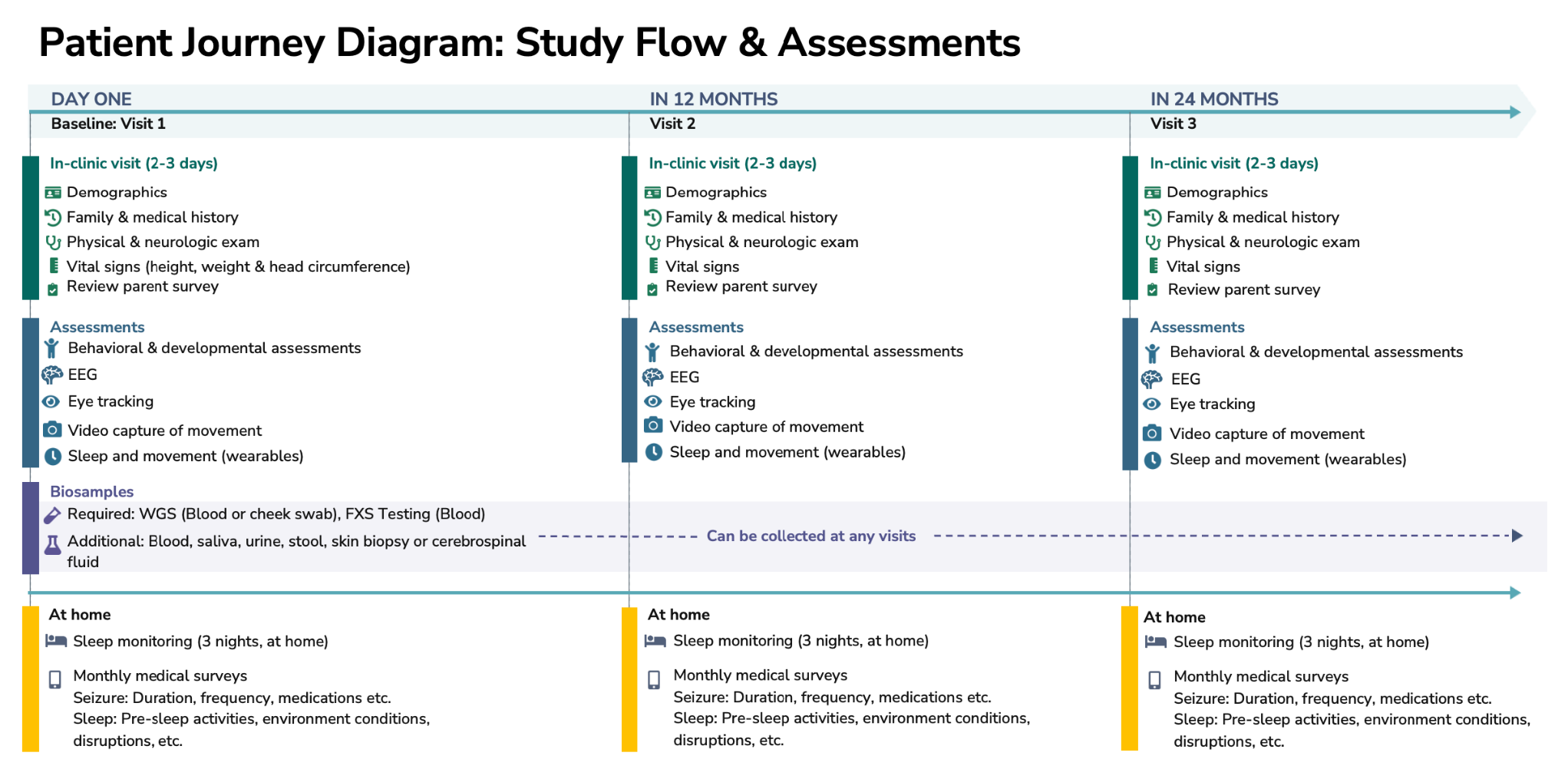
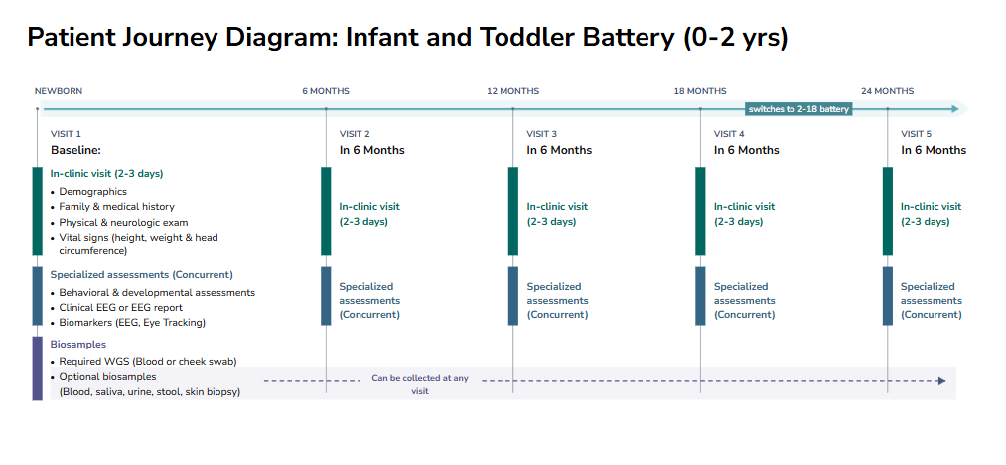
Study Phases#
- Initial eligibility confirmation documenting a genetic test report (Cohort 1) or developmental/behavioral screener confirming ASD with significant cognitive and language impairment (Cohort 2)
- Baseline (Visit 1) & Observation Period (Visits 2-5): see details below.
- Monthly medical surveys documenting sleep, behavior, medications, and seizures throughout study participation
| Activity | Ages 0–2 Years | Ages 2–18 Years | ||
|---|---|---|---|---|
| Visit 1 Baseline |
Visits 2–3 Every 6 months (±2 wk) |
Visit 1 Baseline |
Visits 2–3 Every 12±1 months |
|
| Demographics | ||||
| Family & Medical History / Physical & Neurologic Exam / Vitals | ||||
| Behavioral & Developmental Assessments | ||||
| Required WGS Biosamples (Blood or Cheek/Buccal Swab) | ||||
| Required Fragile X (FXS) Testing (Blood) — Cohort 2 only | — | — | ||
| Additional Biosamples (Skin biopsy, urine, stool, excess tissue/CSF) | ||||
| Biomarkers (EEG, Eye Tracking, Motor Assessment) | ||||
| At-Home Sleep Monitoring (Sleep EEG, Actigraphy) | — | — | ||
| Standard, 24-Lead Clinical EEG | — | — | ||
Visit Scheduling#
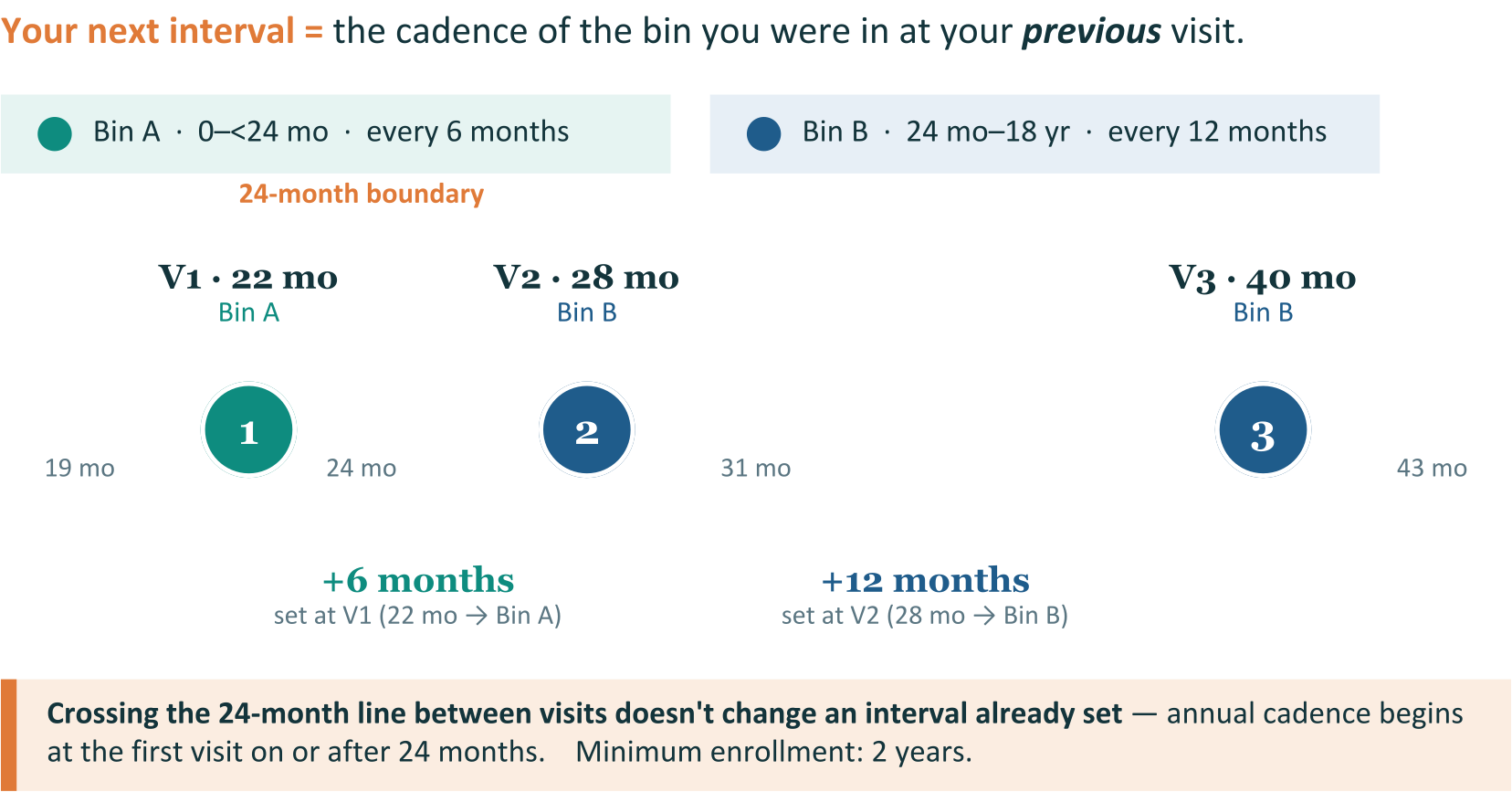
Rules & Edge Cases#
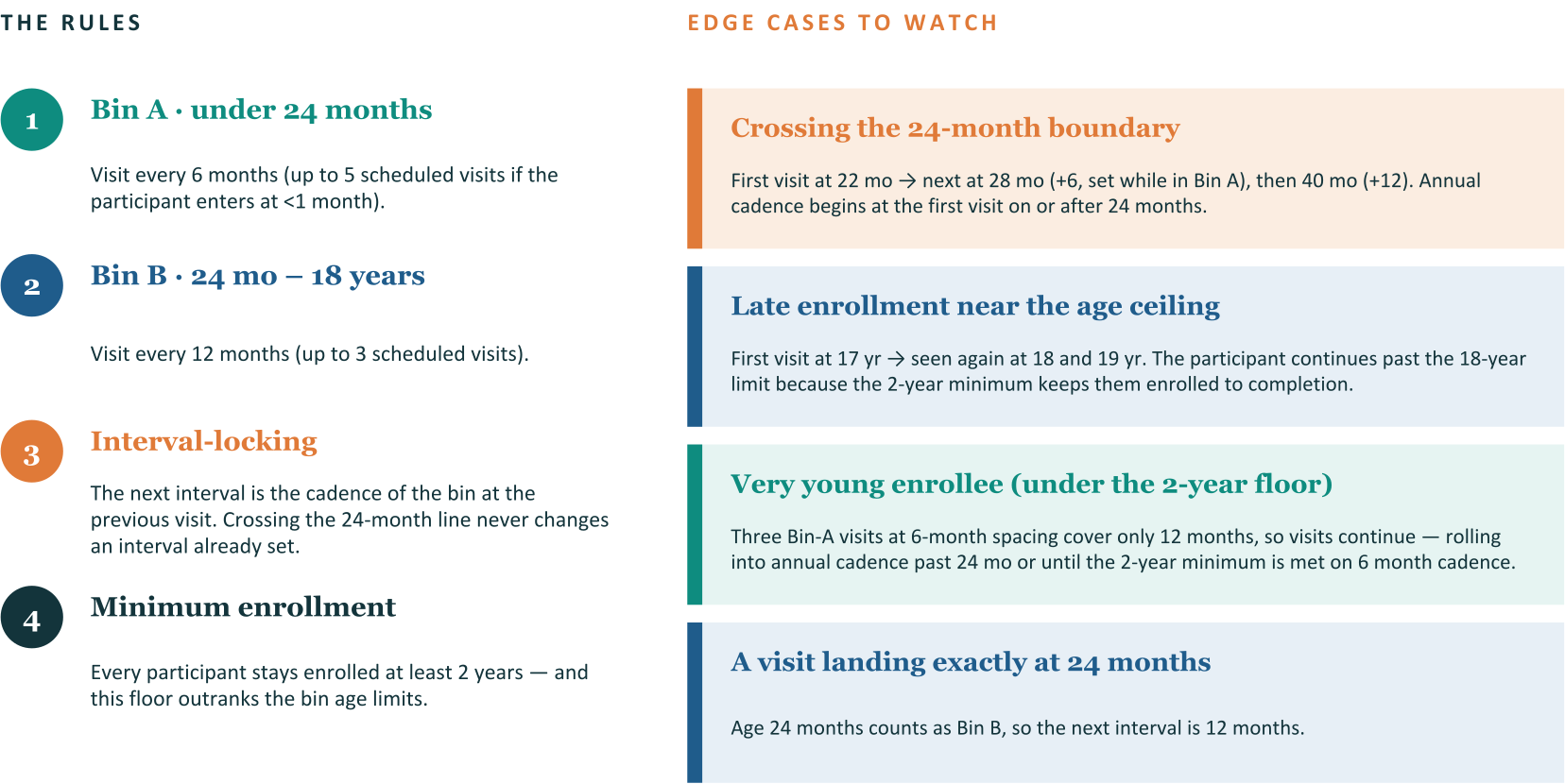
Visit Schedule At A Glance#